

Airway Orthodontic Treatments for Kids in Gilbert

Does Your Child Snore?
Snoring and mouth breathing in growing children can indicate an underlying airway concern that deserves attention.
Chronic mouth breathing in growing children alters the way their upper and lower jaws develop. Such abnormal growth patterns in the jaws may require surgical correction later in life if not identified and addressed early. Mouth breathing can also indicate an airway obstruction, leading to poor sleep quality and subsequent problems with neurocognitive development and whole-body growth. When caught and treated early, we have the ability to guide the skeletal growth trajectory and make tremendous, lasting positive changes.
Normal skeletal and dental growth of the face and jaws depends on even pressure from the lips and cheeks on the outside, and from the tongue on the inside of the mouth. Children with nasal obstruction caused by asthma, allergies, a deviated septum, or enlarged tonsils and adenoids are often forced to breathe through their mouths. When a child’s mouth is open most of the time, the lips are not together and the tongue is not exerting the proper pressure on the upper jaw and teeth. This leads to an open bite skeletal pattern, a longer lower face, and an underdeveloped upper jaw. Mouth breathing can also lead to an increase in cavities, due to the drying of the saliva, which has natural properties to fight the bacteria that causes cavities.
Another contributing factor is a tethered tongue (tongue tie), where the tongue cannot rest comfortably in the roof of the mouth—preventing normal development of the upper jaw. A tethered tongue can also obstruct the posterior airway because the child is unable to position the tongue up and forward, keeping it out of the back of the throat.
Signs to Look For in Growing Children
Signs of an Underdeveloped Jaw
- Dry and chapped lips
- Open-mouth posture while sitting still (inability to keep lips together)
- Chronic runny nose and/or allergies
- History of chronic ear infections
- Dental crossbite
- Dental crowding and/or delayed eruption of adult teeth
- Red or swollen upper gums
- Always eats with mouth open
- Anterior open bite (front teeth do not overlap)
- Underbite or overbite
Signs of a Possible Tongue Tie
- History of difficulty breastfeeding
- History of speech therapy
- History of difficulty swallowing or extreme food preferences
- Inability to place tongue comfortably on the roof of the mouth
A dental crossbite is a sign that the tongue is not resting in the roof of the mouth. If not addressed early, a small upper jaw may lead to incorrect or even blocked eruption of adult teeth and a compromised airway.
Signs of an Obstructed Airway
- Have you heard your child snore?
- Have you observed your child stop breathing during sleep?
- Have you heard your child grind their teeth at night?
- Does your child toss and turn throughout the night?
- Is there a history of bedwetting?
- Do you observe daytime sleepiness or low energy?
- Does your child wake with morning headaches?
- Do you notice hyperactivity and/or difficulty paying attention to tasks?


How We Evaluate and Treat Airway Issues in Children
At Avelle Orthodontics, identifying and addressing airway concerns in growing children is one of the most impactful things we do. A comprehensive airway evaluation includes a detailed health and development history, a clinical examination, and advanced 3D imaging. This allows us to assess the size and position of your child’s jaws, trace the airway, identify any areas of restriction, and understand how current growth patterns may be affecting their breathing and sleep.
Because children are still growing, we have a unique and time-sensitive opportunity to guide jaw development in a positive direction—before problems become more complex or require more invasive solutions later in life.
Palatal Expanders: Creating Space for a Healthy Airway
One of the most effective and well-established tools we use for children is the palatal expander. During childhood and early adolescence, the midpalatal suture is still open and actively growing—this creates the perfect window for guided expansion that is both effective and minimally invasive.
A palatal expander is a custom-fitted appliance that gently widens the upper jaw over a period of weeks to months. By gradually expanding the palate, we are able to create more room for the tongue, correct the jaw growth, allow adult teeth to erupt properly, and—importantly—increase nasal airway space for better breathing.
The benefits of palatal expansion for children’s airway health include improved nasal breathing, reduced mouth breathing, better tongue posture, a wider and more open airway during sleep, and a healthier foundation for the permanent teeth. Many families notice improvements in their child’s sleep, energy, and behavior as breathing becomes easier.
Because children’s bones are still developing, expansion at this stage is highly effective and produces stable, lasting results. Acting during this growth window means we can help redirect your child’s development naturally—without the need for more complex treatment down the road.
At Avelle Orthodontics, every expander is carefully planned using 3D imaging to ensure precise, targeted treatment. If you have noticed any of the signs listed above, we encourage you to bring your child in for an evaluation—early action makes all the difference.
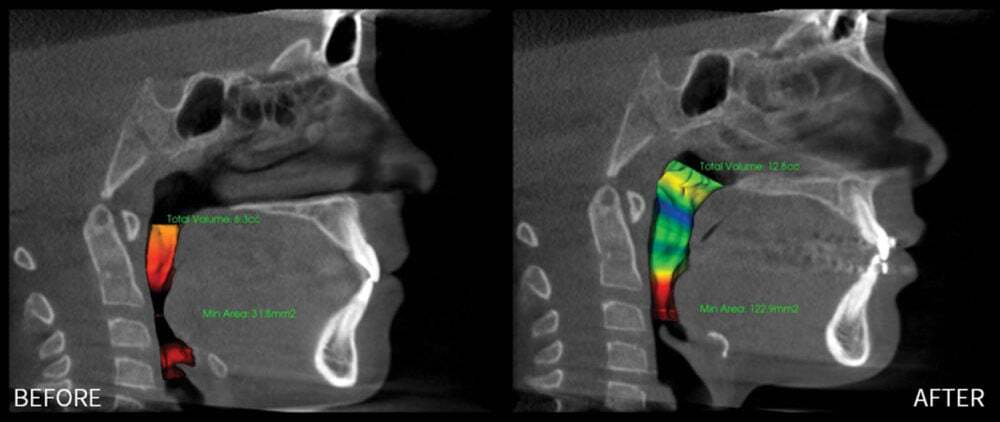
Before & After: Airway X-Ray
Next Steps
Take this simple pediatric sleep questionnaire and see how your child scores on the assessment.
After your child’s evaluation, our team will guide you through the most appropriate course of action. Possible next steps may include:
- A pediatric sleep study to assess breathing patterns during sleep
- Collaboration with a pediatric ENT if tonsils and adenoids need to be evaluated or removed
- Correction of a tongue tie with a specialist
- Myofunctional therapy—working with a specialist who helps retrain the tongue and breathing muscles
- A palatal expander to make room for the tongue, correct jaw growth, allow adult teeth to erupt normally, and increase nasal airway space
If we diagnose and address airway concerns early in growing children, we can help change their growth trajectory—supporting healthier development, better sleep, and a lifetime of easier breathing. Our goal is always to be proactive so your child never has to face more complex treatment later on.
At Avelle Orthodontics, we are here to guide you and your child every step of the way.
Airway FAQ
Is it normal for my child to snore?
When we talk about airway health, a common question parents ask is, “How do I know if my child might have an airway issue?”
The first step is simple, start by asking the right questions. Sometimes it’s as easy as going through a quick questionnaire that highlights the most common signs we see in kids with airway concerns.
At Avelle Orthodontics, there are a few key indicators we want parents to be aware of. Things like consistent snoring or labored breathing during sleep—just to be clear, snoring in children is not normal. Mouth breathing is another important sign. You might also notice teeth grinding at night, asthma, dark circles under the eyes, or even bedwetting.
Some children may show signs like difficulty focusing, hyperactivity, or night terrors.
The important thing to understand is that airway issues can show up in many different ways, and they’re not always obvious.
That’s why the first step is simply asking—”Could this be affecting my child?”
If you notice any of these signs, or if something doesn’t feel quite right, our team at Avelle Orthodontics is here to help guide you through the next steps. One of the most informative and simplest steps to do is to fill out the Pediatric Sleep Questionnaire and then see how your child scores on that assessment.
Benefits of Better Sleep
One of the most unexpected—and truly rewarding—parts of what we do at Avelle Orthodontics is hearing from parents during treatment, about the quality of life changes they see in their child.
Sometimes, parents will say things like, “I feel like I should have known sooner.” But as we talk more, what they really share is this sense of surprise—how much better their child is doing.
They’ll tell us, “I didn’t realize my child could sleep this well,” or “They’re finally sleeping through the night.” There’s no more tossing and turning, no more restless sleep. Sometimes they mention that their child is doing much better in school, or that their child is finally getting back to normal on their growth chart.
And often, it impacts the whole family. Parents are sleeping better too, especially if their child used to wake up frequently or sleep in their room.
There’s this moment where it all clicks—and they wonder why they hadn’t heard about this before. Because most people don’t immediately think of going to an orthodontist for sleep or breathing concerns.
Of course, we love seeing improved smiles and healthier bites—but what’s even more meaningful is the impact on how a child feels every day. Orthodontics is not just about straight teeth, it is about much more! It is about getting the structures of the jaw and soft tissue in the correct relationship with each other and the face so that we have a healthier child and a stable result!
Sleeping better, breathing better, having a beautiful smile and truly thriving.
That’s what makes this so rewarding for us, where we are truly impacting on how people live their lives!
Airway Red Flags
When a child’s airway is compromised during growth, it can affect their overall development in ways that may be very difficult to correct later on.
What’s even more concerning is that many parents—and even children—may never realize there was an airway issue to begin with.
When a child isn’t breathing properly or getting adequate oxygen, it can impact how they grow, how they sleep, and how they function day to day. In some cases, children may simply not thrive the way they should, because they are not breathing the way they were meant to.
At Avelle Orthodontics, we believe every child deserves the opportunity to reach their full potential—with optimal health, proper growth, and quality sleep.
That’s why we want to give you, as a parent, peace of mind.
We’ve created a simple airway questionnaire as a screening tool to help identify whether your child may be experiencing an airway issue—and how it could be affecting them.
We’ve included a link below, and it only takes a few minutes to complete.
If you have any concerns after taking it, our team at Avelle Orthodontics is here to help guide you every step of the way.
Allergies? Genetics? Find Out More.
The factors that lead to airway insufficiency in children typically fall into two categories: genetic and environmental.
Genetically, your child may have enlarged tonsils or adenoids—you may have experienced the same thing growing up. But while yours may have naturally reduced over time, theirs may not.
On the environmental side, factors like allergies, asthma, or habits such as thumb sucking can play a role. Some children develop patterns like mouth breathing or improper tongue posture, which can influence how they grow, how they chew, and even how they eat.
The key is understanding that it’s usually not just one cause—it’s a combination of factors.
At Avelle Orthodontics, we take a comprehensive approach. Through a detailed questionnaire and medical history, we’re able to identify these contributing factors and better understand how they may be affecting your child.
From there, we can make an accurate diagnosis and guide you toward the most appropriate treatment.
What is the Best Age for an Airway Evaluation?
The value of an early orthodontic evaluation—around ages 4, 5, or 6—is really about timing and opportunity.
Whether you’ve noticed a concern or simply want peace of mind, seeing a child early allows us to identify issues while they’re still growing—and that makes a big difference.
There are certain things we can guide and correct at a young age that become much more difficult, to address later on. For example, once the upper jaw has finished growing, our ability to expand or reshape is still available, but the procedures become more complex.
But when we see children during their active growth years—typically between ages 4 and 7—we have a unique window where we can intervene early and create long-lasting, more ideal outcomes.
Another example is teeth grinding. It can be very hard for parents to notice because it happens gradually—almost like watching your child grow. You don’t always see it happening day to day, but over time, the effects can add up.
If grinding is related to an airway issue and we catch it early—before or just as the permanent teeth are coming in—we can help protect their teeth and prevent long-term damage.
That means avoiding more extensive treatments later on, like crowns, fillings, or veneers to repair wear that happened during childhood.
At Avelle Orthodontics, our goal is to be proactive, not reactive.
Does Maxillary Expansion Help Airways?
At Avelle Orthodontics, we’ve been using rapid maxillary expansion for many years in young children, typically between ages 5 and 12—and occasionally even in 3- and 4-year-olds when we see they could benefit.
This treatment was originally developed to correct deficient jaw structures, helping children achieve a full set of teeth, broader smiles, fuller lips, and more aesthetic facial profiles. It can even contribute to healthier soft tissue development and fewer facial wrinkles as they grow.
While we were always aware of airway health, we didn’t have precise ways to measure it—until now.
Current research shows that rapid maxillary expansion not only supports proper jaw growth, but also improves nasal airway ventilation, enlarges the pharyngeal airway, and encourages better tongue posture. We see these improvements every day—and now we can measure them.
Orthodontic expansion is one of the primary ways we address airway issues, especially when the size of the jaws is limiting a child’s ability to breathe properly. Using 3D imaging, we can trace the airway, identify any constrictions, and develop a targeted treatment plan.
Another way we support airway health is by creating sufficient room in the mouth for important structures, like the tongue and base of the tongue. If a child’s teeth are constricted or tipped inward, there isn’t enough space for these tissues, which can push back into the airway. By expanding the jaws and aligning the teeth, we give the tongue and other tissues the room they need, opening the airway for better breathing during sleep, exercise, and daily activities.
If you notice any signs or have concerns, our team at Avelle Orthodontics is here to guide you every step of the way.
Is My Child Struggling?
When a child has airway issues, it can affect the quality of life for the entire family—often in ways parents may not even realize.
From simple worries about whether their child is thriving, to more complex challenges that impact family dynamics, the effects can show up in many ways. Families going through this know exactly what we mean.
Children who aren’t breathing or sleeping well may struggle to be their best selves. Poor sleep, difficulty eating, or limited nutrition can affect their growth, mood, and daily functioning.
These issues often ripple through the household, showing up in unexpected ways. That’s why early detection is so important.
At Avelle Orthodontics, we’re here to help you understand if your child may be experiencing airway issues and how they could be affecting their growth, sleep, and overall well-being.
If you notice any signs, our team is ready to guide you and provide support every step of the way.
Benefits of Airway Treatment
Our early orthodontic treatments are designed to improve deficient jaw structures and support normal development of the face, jaws, temporomandibular joints, teeth, and airway.
Twenty years ago, we didn’t have precise ways to evaluate individual jaw sizes or see how the upper and lower jaws compared. We could estimate with 2D imaging and look at crowding, but that only told part of the story.
Now, with advanced imaging, we can accurately assess jaw size and growth. From an orthodontic standpoint, we can expand jaws that are too small—especially the upper jaw—creating more space where it’s needed.
These treatments can routinely double, triple, or even quadruple the size of the airway, significantly improving breathing. Better breathing, especially during sleep, allows the body to rest and heal, giving your child the greatest chance to thrive.
Supporting proper jaw and airway development can positively affect physical, mental, and emotional growth—it truly can change a child’s world.
At Avelle Orthodontics, we’re here to guide you and your child toward healthy development and lifelong well-being.
We're Here to Help You
With any airway concern, the sooner it’s addressed, the greater the benefit for your child.
At around age 4, children are going through critical growth stages. This is also when tonsils and adenoids are proportionally at their largest.
If we wait until they reach adolescence, much of the jaw development that could have been guided has already occurred, and an insufficient airway may already be affecting your child. This can make orthodontic treatment more complex later on.
Early evaluation and intervention give your child the best chance for healthy jaw development, improved airway function, and overall growth. At Avelle Orthodontics, we’re here to guide you and support your child every step of the way.
How Long Does Airway Orthodontic Treatment Typically Take?
The duration of Airway Orthodontic treatment varies depending on individual needs and the age of the patient. For adults, typically, it can range from 18 to 24 months. For children it is often closer to 12-15 months. The process is tailored to each patient, ensuring the most effective and efficient treatment plan. Regular check-ins and adjustments are part of the journey, ensuring progress towards improved airway function and optimal alignment.
What Age Groups Can Benefit from Airway Orthodontics?
We begin Airway-driven treatment as early as 3 years old, tailoring our approach to each individual’s age and needs. Our specialized procedures enable us to offer this treatment to adults up to 65 years old, with techniques adapted to different age groups.